
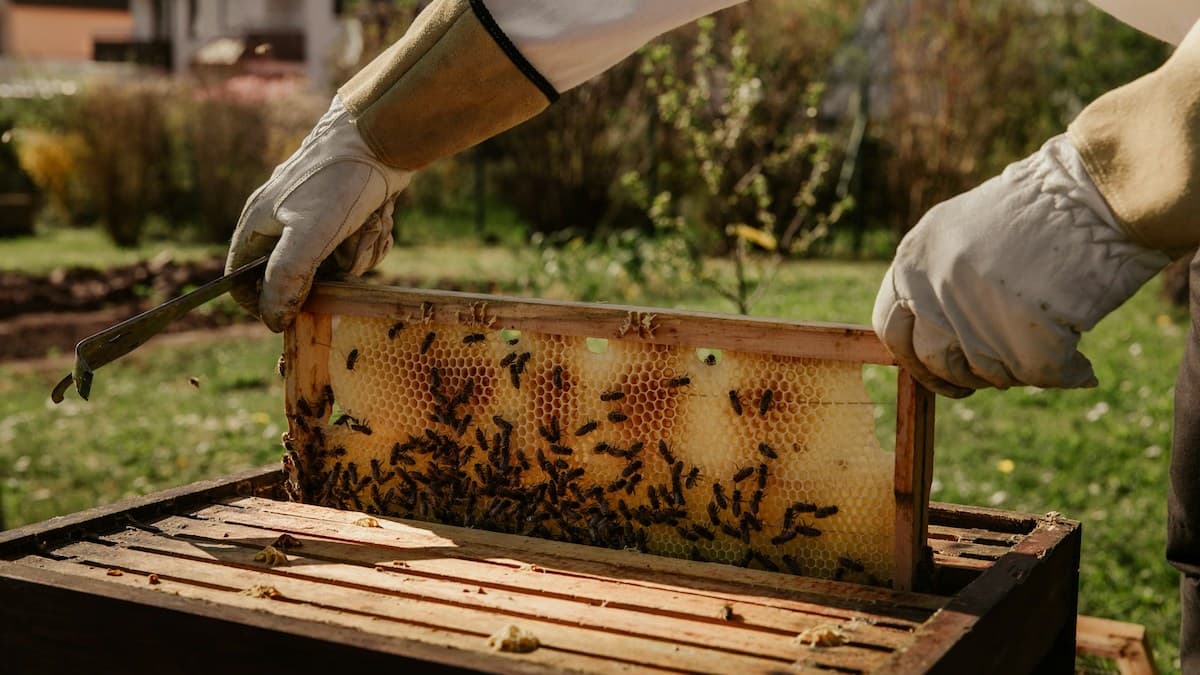
On a farm in the heart of Philadelphia, there’s a buzz in the air — not from the busy city surrounding it, but from the thousands of honeybees flying in and out of their hives.
Meet Isabella Higgins, a farmer and beekeeper at the non-profit Urban Creators farm. She’s one of a growing number of young urban farmers in Philadelphia working to address food insecurity through urban beekeeping and agricultural initiatives.
The Urban Creators farm was founded in 2010 by a diverse group of Philadelphians, including students and activists who collaborated to turn a two-acre plot of vacant land into a farm. Today, it continues to create a generation of urban creators who use food and education to instill resilience and self-determination in their neighborhood.
Higgins’ journey into beekeeping just began last year, when she enrolled in the nonprofit BeeConservancy’s free beginner beekeeping training program for farmers and gardeners improving underserved urban communities’ access to fresh produce.
For her, beekeeping goes hand-in-hand with her food justice efforts. Bees are known as a keystone species; research suggests that one in every three bites of food exists because of honeybees and other pollinators.
“Bees pollinate flowers, flowers turned into fruits and vegetables,” Higgins explains. “The herbivores are eating those fruits and vegetables, and the carnivores are eating the herbivores … Take away the bees and you take away everything.”

Higgins’ farm is located in the North Philadelphia neighborhood of Hartranft, a mostly Hispanic and Black community that faces food apartheid – a word scholars and activists use to remind the public that food insecurity is perpetuated by government policies and other structural inequities.
“This is a majority-Black neighborhood that has been actively disinvested and kind of left to die, almost,” she tells Analyst News. “There’s no money going into this neighborhood. You’re more likely to find like a corner store or a liquor store than a grocery store with fresh produce. The tree canopy is less, on average. Hartranft is like 10 degrees hotter than wealthier parts of the city, because of a lack of tree coverage.”
Recent research from the Brookings Institute found that grocery stores focused on organic food are “less likely to be located in Black-majority neighborhoods” across American cities — just one example of how businesses, the real estate industry and finance sector’s lack of investment in Black neighborhoods hinders minority communities’ well-being and growth.
That makes the Urban Creators farm’s work crucial for its neighbors. The farm maintains one of the area’s largest tree canopies and provides fresh produce and honey to local residents on a sliding scale, a boon as inflation pushes up the price of food.
“We’re really a microcosm of agricultural possibility,” Higgins says. “We are such a small space. We’re actively farming one acre, just about, and we’re producing over 2,000 pounds of food every season.”
A recent food insecurity report released by Feeding America said that as of 2019, 14.4% of Philadelphians experience food insecurity. For Philadelphia’s children, the rate is even higher, with almost one in four children “lacking enough access to food for an active and healthy lifestyle.”
Last year, the City of Philadelphia published its first urban agriculture plan, recognizing the work of Urban Creators and outlining a new 10-year framework for cultivating healthy food systems and green spaces. A number of community-based agricultural projects, including the Sankofa Community Farm and Philadelphia Orchard Project, helped shape the plan and are now helping implement its vision.
“We can build a racially and economically just 21st-century local food system if we redistribute and invest long-term resources to build sustainable infrastructure for agriculture in the city.”
“We can build a racially and economically just 21st-century local food system if we redistribute and invest long-term resources to build sustainable infrastructure for agriculture in the city,” Philadelphia Parks & Recreation department officials said in the report.
Advocates believe the answer is serious investment in community-led urban agriculture initiatives. Beekeeping and agriculture can be prohibitively expensive to many low-income residents, Higgins notes, and she hopes to secure government funding to launch a paid apprenticeship program in the next year.
“There is less access to green spaces, to bees and beekeeping and agriculture, in low-income communities of color, and for that reason, they need far more investment,” Higgins says. “It requires remediation – remediation of the land, [as] a lot of poor neighborhoods and neighborhoods of color have higher levels of lead and arsenic and heavy metals in their soil.”
All of that has serious, long-term and intergenerational consequences for low-income communities’ health, which are disproportionately impacted by diabetes, heart disease, mental health issues and other conditions.
But there, too, urban farming and beekeeping programs offer a solution.
Research suggests that spending time with nature can alleviate mood disorders, and the public health benefits of green spaces, gardening and access to fresh produce are all well-established in scientific literature.
But honey – especially local honey, produced within a two-mile radius – and its byproducts, including propolis, beeswax and pollen, have all been shown to have health benefits. Various studies have also shown that being around bees can help address PTSD, stress, anxiety and depression, making community beekeeping programs a relatively low-cost public health intervention with real therapeutic power.
“There is something inherently healing about their energy,” Higgins says. “These are very community-based organisms. When you look at the way they structure their little societies, you can see a lot of parallels with ours. There’s so many lessons to learn from them.”