
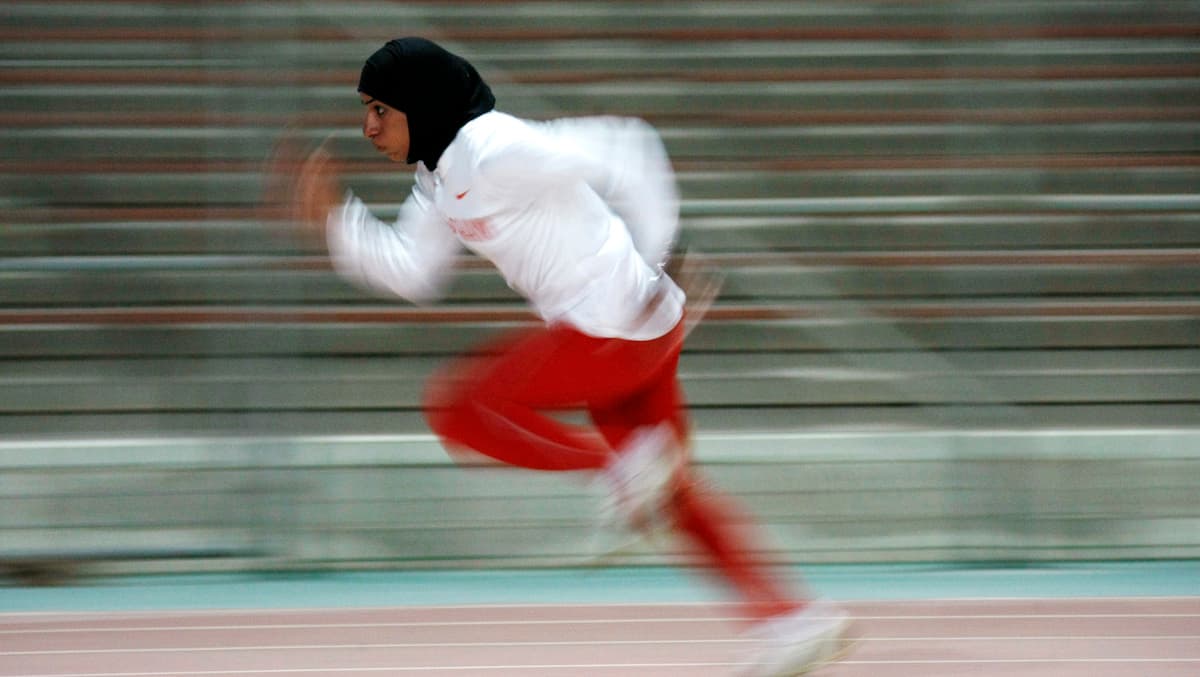
Tina Rahimi wants to win more than just gold at the upcoming Olympic Games in Paris.
“I just hope that I can show these women that you can do these things and still be true to yourself and true to your beliefs and your faith without being uncomfortable,” the boxer told 9News.
But Australia’s first Olympic female Muslim boxer, who wears a hijab, wouldn’t have that chance if she were representing France.
The host country of the 2024 summer Olympics has banned the hijab for its own athletes. It’s a move that has been criticized internationally for depriving already-marginalized groups from equal opportunities as well as role models in the sports world.
“The practice of sport is a human right,” reads the Olympic Charter. “Every individual must have access to the practice of sport, without discrimination of any kind in respect of internationally recognised human rights within the remit of the Olympic Movement.”
The Olympic Games are, from their roots, a religious affair. Created in honor of Zeus, athletes prayed to the ancient Greek deity for victory and offered him sacrifices.
But today in France, not only can players not display their faith in their Olympic uniform, they often cannot wear religious head coverings in sports teams on a smaller scale.
The country’s targeting of the hijab over decades means “very few such sportswomen have reached this level of competition — or — that they were forced to abandon a part of their identity to reach it,” says Amnesty International in a recent report.
The rights group argues that the ban violates international human rights laws and must be taken seriously by the International Olympic Committee, especially considering that the Paris Olympics boast to be the first Games with full gender parity.
According to the report, the committee has responded to calls to end the ban by saying that the decision is outside the scope of the Olympic movement and that “freedom of religion is interpreted in many different ways by different states.”
“When the world will be watching its athletes compete for medals and exercising their right to practice sport without discrimination, it should also cast a critical eye on the Olympics host country, which does not apply Olympic values to everyone.”
While there’s no French law banning religious headwear in sports, the country is the only one in Europe where individual sports organisations have been imposing such bans themselves, the report adds.
“When the world will be watching its athletes compete for medals and exercising their right to practice sport without discrimination, it should also cast a critical eye on the Olympics host country, which does not apply Olympic values to everyone,” the human rights group said.
France’s decision has also been criticised by former Olympian Ibtihaj Muhammad, a 2016 U.S. fencing medalist who wears a hijab.
“Shame on France!” Muhammad posted on Instagram on World Hijab Day. “We need laws in place that insure future Olympic host countries uphold the fundamental principles of the Olympics and that all athletes, INCLUDING MUSLIM WOMEN, are allowed to compete without facing discrimination.”
Other former Olympians such as Doaa Elghobashy, an Egyptian beach volleyball player who wore a hijab in addition to her team’s uniform of long sleeves and pants; Wojdan Shaherkani, a judoka who competed in the hijab as the first Saudi woman to ever compete at the Games; Giana Mohamed Farouk, an Egyptian karate medalist; and Hedaya Malak Wahba, an Egyptian taekwondo medalist all broke barriers for Muslim women’s participation in sports.
As one French volleyball player explains, that right is currently being denied to French citizens.
“We accept others who will come with their headscarves, their turbans, but when it’s French women, it’s impossible. This is very hard. It’s very, very hard to see that, to hear that,” Assma told Amnesty International.
“In my feminist struggles, I want women to be able to dress how they want, how they wish. … It’s not just a ‘Muslim issue,’ it’s a human issue.”