
In the early 1970s, Venezuela was a thriving nation: It had the largest oil exports in the world, making it the richest South American country and among the 20 wealthiest nations on Earth. In the decades since, its economy has seen a free-fall and a swift collapse that’s left a brutal scarcity of food and medicine.
Elected in 2013, Venezuelan President Nicolas Maduro inherited a country in rapid decline and oversaw a nation suffering from extreme hyperinflation, turmoil and poverty. Now, due to a mix of poor economic policies over decades, over-reliance on its oil exports and crippling U.S. sanctions, it is among the region’s poorest countries. Almost 90% of Venezuelans live in poverty.
Maduro, widely recognized as an illegitimate ruler who rigged the 2024 elections and whose government presided over extreme human rights violations, was abducted by American forces in the early hours of Jan. 3. He now faces drug trafficking charges in the United States.
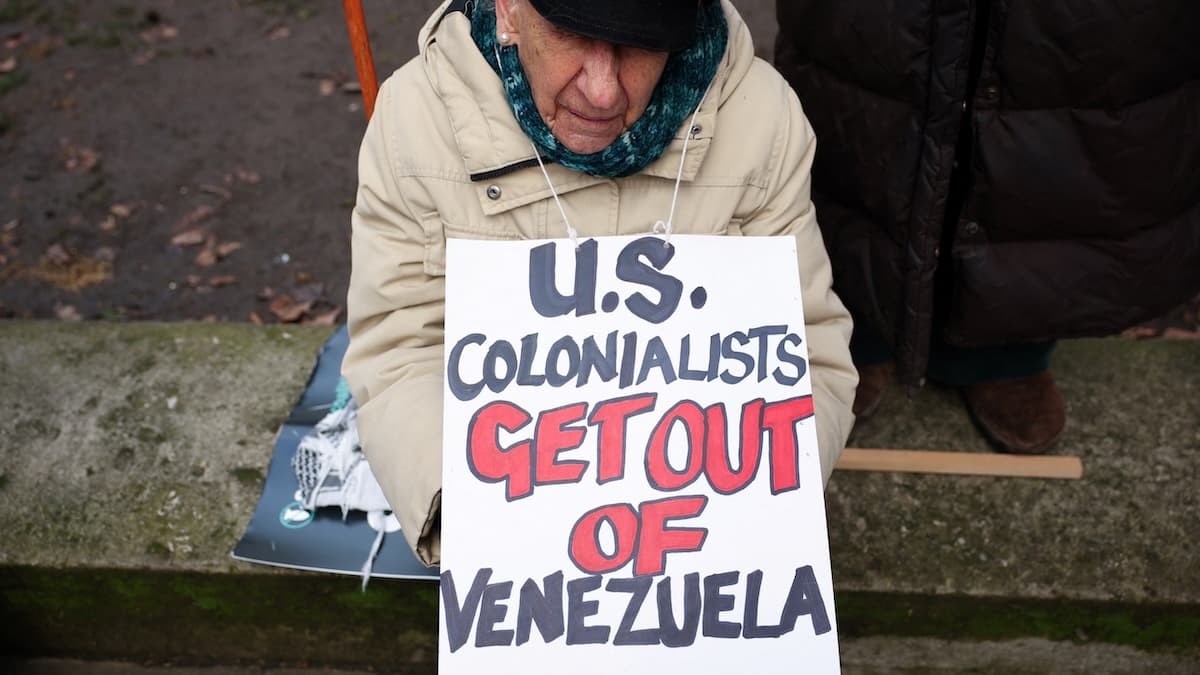
Some in Venezuela and its diaspora are understandably jubilant that Maduro, a repressive dictator, has been abducted and removed from office. But history shows those jubilations will be short-lived. The brazen violation of their national sovereignty and President Trump’s audacious declarations that “the U.S. will run Venezuela” and that “this is OUR Hemisphere” promise a darker future.
We’ve seen where this road leads. During the illegal invasion of Iraq in 2003, many Iraqis celebrated that Saddam Hussein’s oppressive and cruel rule had come to an end. However, shortly after, the country was plunged into chaos. Iraqis were regretful. The United States took what it wanted — oil — and left the country in ruins.
“I toppled Saddam’s statue, now I want him back,” one Iraqi told the BBC in 2016. Since the U.S. invasion in 2003, which killed 1 million people per some estimates, the country has been fragmented, fractured by the rise and brutality of ISIS, and continues to be bombed by Western powers to this day. So much for Iraqis regaining their freedom and sovereignty.
Even setting aside the illegality of a nation abducting another nation’s sitting president, legitimate or not, no one should forget how each and every intervention by the United States plays out. It’s the same pattern every time: Washington frames regime change as liberation, demonizes and takes down the leader in power, secures American strategic interests — often oil — and leaves behind mass death, shattered sovereignty and instability that lasts long after the United States has left.
U.S. propaganda
It always starts with a farcical propaganda campaign, insincere sympathies and concerns for the people of the soon-to-be colonized country and wild justifications for attacking it.
In 2003, we were told that weapons of mass destruction and removal of a ruthless dictator were the motives of the Iraq War. American forces invaded Iraq “to free its people,” then-President George W. Bush told the world.
It’s now widely acknowledged that oil and resources were the real aims. There were no WMDs and no imminent threats facing the United States.
Today, we’re told Maduro is an illegitimate ruler who oppresses his people and is the head of the Cartel de los Soles — a fictional drug cartel invented by U.S. officials — and that he floods narcotics into the United States. This outright lie was quietly removed by the Department of Justice’s indictment of Maduro just days after his abduction.
“Nicolas Maduro is responsible for … repressing the people of Venezuela,” Ambassador Mike Waltz told the U.N. Security Council two days after Maduro’s abduction. That may well be true. But the United States didn’t seem to care much for the safety or prosperity of Venezuelans when it slapped heavy sanctions on the country, contributing to its shortages of food and medicine.
No one should be in any doubt that the welfare of the Venezuelans is the last thing on Trump’s mind. He says American oil companies will go in and “do a great job for the people of Venezuela.” From one side of his mouth, he proclaims “America First”; from the other, he feigns concern and goodwill for the people of Venezuela. Which is it?
We saw similar propaganda tactics when it came to Iran, too. A whole host of arguments were used to justify America’s strikes in June 2025: Iran’s so-called nuclear threat, women’s rights, regional security, even absurd excuses that Iranians “hate our way of life” and “want to eliminate Western society.”
It’s easier to sell a lie when there are elements of truth baked in. Both Nicolas Maduro and Saddam Hussein were dictators, but neither of them posed an imminent threat to the United States and were never likely to. Yet pointing to this repression — and playing on racist tropes to forward claims of drug trafficking and terrorism, respectively — made this propaganda easy for the public to swallow.
Hypocrisy of propping up dictators
The United States has a long, sordid history of staging coups to overthrow elected leaders. It supports dictators when it suits it and removes them when it doesn’t. In fact, there are at least 70 documented U.S. regime change operations since 1947.
Take the case of Chile in the 1970s. Salvador Allende was a popular socialist presidential candidate who sought to nationalize the country’s copper industry. The CIA ran a propaganda campaign against him and he lost the 1964 election, but in 1970 he ran again and won. The United States then attempted to foment a coup and placed economic restrictions to make it impossible for him to govern. In 1973, Chile’s military overthrew him, and army chief Augusto Pinochet took over, ushering in an era of oppression in a brutal dictatorship. More than 3,000 people were either disappeared or killed, and thousands of political prisoners were tortured.
A similar story played out two decades earlier in Iran. The CIA and the U.K. manufactured a coup to overthrow the democratically-elected prime minister of Iran, Muhammad Mossadegh, in 1953 because he nationalized its oil. He was replaced by the autocratic ruler Mohammad Reza Pahlavi, known as the Shah of Iran. He went on to oppress the Iranians and oversaw a brutal police state, eventually leading to the 1979 revolution and the semi-theocratic state of Iran today. American neocons rail against Iran’s government today, but it was imperialist ideologies like theirs that led to it in the first place.
Supporting dictators has been part and parcel of U.S. foreign policy for decades. Washington backed Pakistani dictators General Zia-ul-Haq and Field Marshal Mohammed Ayub Khan in the latter half of the 20th century; though Pakistan was built on the principles of pluralism, Zia-ul-Haq turned the country into an intolerant semi-theocracy and undermined its democratic institutions, marginalizing minorities and weaponizing blasphemy laws to appease radical Muslim clerics. To this day, he is reviled in Pakistan.
Today, the United States supports almost 75% of the world’s dictators and autocracies with weapons and money. President Trump justifies Maduro’s abduction by saying he was an illegitimate dictator, but he has no issue shaking hands with Muhammad bin Salman, Kim Jong Un and Vladimir Putin — all of whom have been accused of repression and autocratic rule — and has even expressed admiration for them. But when it’s a country that has oil, the dictator must be toppled.
The hypocrisy is glaring. The operation in Venezuela took place without congressional approval, in clear violation of the U.S. system of checks and balances. President Trump notified oil companies first, rather than informing Congress. What does that say about illegitimate rule and authoritarian behavior in America? And yet, Washington continues to police other nations on democracy, human rights and the rule of law.
A dangerous precedent
Usurping Venezuelan oil was always the primary motive, as openly admitted by Trump before and since the abduction. “They took all of our oil not that long ago, and we want it back,” he’s claimed.
American companies did indeed set up Venezuela’s booming oil industry, until it was nationalized in 1976. Does that give the United States rights to Venezuelan oil for the rest of time? Hardly. American companies never owned the land or the oil and were compensated when they were told to leave.
“A blanket claim of U.S. ownership of Venezuelan oil has no credible basis in international law,” Salvador Santino Regilme, political scientist at Leiden University, told Al Jazeera.
As José Ignacio Hernández, who researches Venezuela’s oil industry, told The Guardian, “Even if a past government illegitimately expropriated the oil assets of U.S. companies without fair compensation, Venezuela did not steal any oil from the U.S.”
International law is clear that a sovereign country owns the resources on its territory and has complete control over it; this principle, known as Permanent Sovereignty over Natural Resources, was established under a 1962 U.N. resolution.
Some commentators have noted that this moment marks the end of the post-World War II international order and has given way to the rule of “might is right.” That might’ve been true if it weren’t for international law having already collapsed long before, with Russia’s invasion of Ukraine, Israel’s genocide of Gaza and the illegal Iraq War in 2003.
But this is indeed another troubling development and sets a dangerous precedent for blatant disregard for international law. What stops China from taking Taiwan or Russia plucking Ukrainian President Zelensky from Kyiv and having him tried in Moscow on trumped-up charges?
Even more urgently, what stops Trump from seizing Greenland as he has repeatedly threatened to?