

“COCAINE.” A red-and-white pop-up flashes across the screen: “You’ve been offered nose candy. What will you do?”
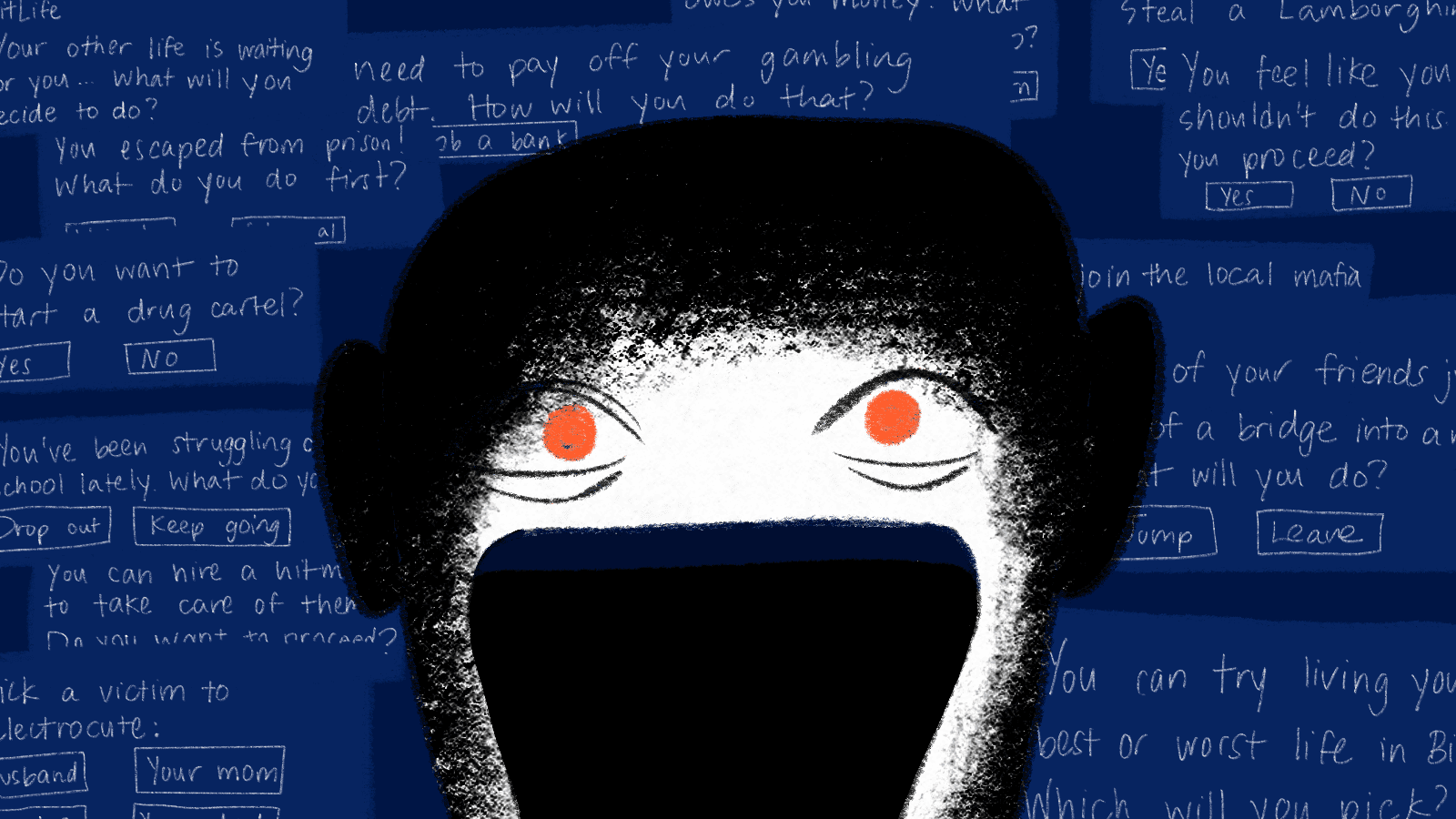
The avatar staring back has wide cartoon eyes and a fixed, empty grin — more Cocomelon toddler than the 20-year-old construction worker he is meant to be. It’s an unsettling contrast as the game cheerfully invites its player to dabble in drugs, sex and crime.
The game in question is BitLife, a popular text-based life simulation app that lets players guide a character from birth to death. It begins innocently enough: from choosing childhood activities to dealing with school bullies. As the player’s character ages, the list of options expands. Players can join school clubs, spend time with family, make friends, date and get married, build a career, join social media and explore countless recreational activities. The game also has additional paid features and add-ons, which give players an ad-free gaming experience or upgrades that allow players to take greater control of their “Bit-lives.”
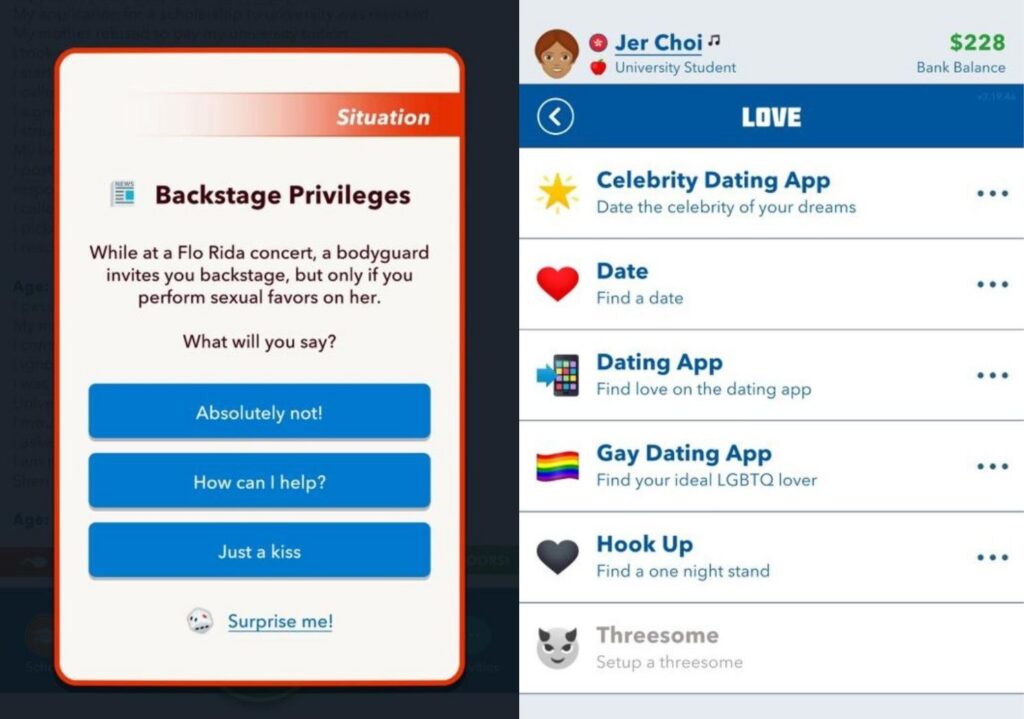
With age, those options take a darker turn. Players can experiment with more explicit and harmful behaviors, from visiting strip clubs and becoming porn stars to committing murder, all through a deceptively playful interface.
Players can experiment with more explicit and harmful behaviors, from visiting strip clubs and becoming porn stars to committing murder, all through a deceptively playful interface.
Across the BitLife subreddit and in gameplay videos from popular YouTube creators, players often gravitate toward the app’s more deviant and criminal scenarios. BitLife becomes the playground for risky and morally questionable decision-making.
These digital behaviors raise important questions. Could a game that rewards experimentation with risky or unrealistic decisions blur the boundaries between fantasy and reality? In other words, can BitLife influence real life?
Inside the adult world of BitLife
BitLife’s cartoon-like aesthetic can make the game look as though it’s meant for children. And while BitLife carries a 17+ age rating, there are no safeguards to verify who actually plays the game. A scan of Reddit threads, Discord servers and YouTube comment sections suggest that a significant number of underage users are engaging with the game.
Even more concerning is what many players are drawn to once inside.
“It’s very inappropriate for younger kids,” says Wasif, an 18-year-old former BitLife player from Dubai, who spoke to us on the condition that his last name be omitted for privacy. He specifically points to the way crime and risky behavior are portrayed, explaining that the “crime aspect that makes it seem really fun wouldn’t be the best for impressionable young students to be playing.”
The game’s cartoon style adds to this effect, he notes, saying that it “makes decisions less serious” especially when there is “a whole section to commit a crime like rob a bank, grand theft auto or you can hack someone’s computer” which feels “goofy or fun.” He believes the game should be age-regulated so children under 16 cannot play it.
Since its 2018 launch, BitLife has been downloaded over 130 million times and maintains over 1 million daily active users. Weekly users in the United States peaked at 2.78 million in late 2023, generating nearly $500,000 in revenue in a single week. Globally, players simulated more than 72 million virtual lives in one year.
And BitLife is riding a broader wave. The global market for life-simulation games is projected to reach $12.5 billion by 2033, growing at a compound annual rate of 7.8%, according to a forecast from market-research firm Strategic Revenue Insights. With mobile users in Asia Pacific driving the fastest expansion — at a projected 9.2% a year — more games modeled on BitLife’s tap-to-live format are likely on the way.
Hooked by design
“With a mix of creativity and lots of black humor, players can make any unfulfilled life dream come true in BitLife: Whether musical star or influencer, billionaire and businessman, ruthless scoundrel or good-for-nothing drifter — anything is possible in BitLife.”
That’s how developer GoodGame Studios — which partnered with BitLife’s developer to bring the game to German players — describes BitLife: a world where every outcome seems just a few taps away. That promise of limitless possibility, experts say, is also what makes the game so hard to put down.
Reddit threads house confessions from users with an irresistible urge to check in on their virtual lives, some boasting of raising as many as 25 generations of BitLife characters, since each death allows players to continue through their character’s offspring. The game’s portable, low-stakes design makes it extremely easy to play on the go.
In 2019, a Pennsylvania high school student shared her struggle with addiction to BitLife. “For days I spent playing life after life, quickly becoming more obsessed with the interactive game and itching for another fix, and even growing irritable if I didn’t play it for more than a day,” wrote Jon’nette Kidd. “At one point, an intervention attempt was made. My friends took my phone and explained that if I wanted to keep my grades up, I would stop playing this game — but my love of BitLife outweighed the love of my friends and family.”
“For days I spent playing life after life, quickly becoming more obsessed with the interactive game and itching for another fix.”
Free games such as BitLife exploit microtransactions and the fear of missing out, fueling their addictive nature, warns Ibrahim Yucel, associate professor in interactive media and game design at SUNY Polytechnic Institute in New York.
“Most of the revenue in games today comes from free-to-play titles that rely on in-game purchases. The system is predatory of people who have FOMO, who will get hooked onto the game and want to experience all the extra content,” says Yucel. In BitLife, these purchases — such as God Mode, Bitizenship or special expansion packs — unlock exclusive careers, pets and achievements, encouraging players to chase “complete” lives.
God Mode lets players edit traits, influence non-playable characters’ willpower and control outcomes, fueling a desire for “perfect” lives. Bitizenship removes ads and unlocks exclusive jobs, pets and ribbons — which appear on a character’s gravestone after their death to memorialize their life. Expansion packs and time-limited challenges promote quick purchases to access new storylines or rewards. Even ad-based boosts create a pay-to-skip system that monetizes impatience.
That kind of design, experts say, may shape players’ long-term relationship with behaviors tied to instant gratification, financial recklessness and even gambling.
José Zagal, professor of game studies at the University of Utah, points to such games’ capacity to shape long-term behaviors. Children are especially vulnerable to extrinsic rewards, he says, like chasing enhanced stats or in-game wealth. In BitLife, success is quantified through ribbons, rare careers and metrics like wealth, status, happiness or longevity. These goals encourage repeated play, turning curiosity into compulsion and reinforcing reward-driven loops.
“When it’s extrinsic motivation, it starts to look a lot like gambling,” Zagal says.
The virtual becomes real
Few expect a BitLife bank robber to become one in real life. But experts warn that the game exposes children and young adults to mature content — violence, sexualized scenarios and adult-themed careers — at an early developmental stage, when they are not fully grasping the implications. The game’s design, they add, can also shape how players respond to reward, risk and impulse in the real world.
“Developmentally, kids have a hard time telling the difference between the screen and their 3D real life,” says Supreet Mann, director of research at Common Sense Media, a nonprofit advocating for kids’ safety and well-being in the digital era. Role-playing these scenarios is inherently different from passively watching content, and repeated exposure can blur the line between experimentation and acceptable behavior, she says.
Broad simulations can also oversimplify life decisions, creating a misleading sense of control. Careers, relationships and financial choices are resolved with a few swipes of a finger, while in reality they involve years of uncertainty, competition and complex trade-offs.
Nowhere is the concern more acute than around sex. Due to BitLife’s highly sexual themes and availability of in-game sexual encounters, young players are constantly exposed to the possibility of encountering and virtually engaging in sexual experimentation. Children’s exposure to ideas affects how they grow up, says Damon De Ionno, managing director of U.K.-based Revealing Reality, which studies children’s experiences of online platforms.
“[There are] a number of young adults whose early online experiences and encounters with pornographic and sexual material have affected their sexuality in the long term and potentially led them to having, what they would describe as, slightly dysfunctional sexual interests,” says De Ionno. “Unfortunately young people are quite impressionable when it comes to early sexual experiences.”
“As adults, we try to shield children from that and allow them to grow up normally and to not see things which are inappropriate for them, but in reality, if people’s early sexual experiences are around things like violent acts or non-consensual acts or things that involve fetish or other things, then obviously that may well affect them later in life,” De Ionno adds.
When shielded by anonymity, players tend to relax their moral boundaries and feel emboldened to act in ways they wouldn’t in real life, De Ionno says. Because BitLife exists entirely within the privacy of one’s phone, it becomes easier for players to make ethical concessions without fear of judgment.
Parents and policymakers should take note
Stillfront, which acquired BitLife’s developer, Candywriter, LLC, in 2020, was asked to comment on the concerns raised in this story. “At this time, we do not have a comment to provide on this matter,” a representative told Analyst News in an email.
On a Reddit forum dedicated to helping people struggling with gaming addictions, one user confessed, “I’m as isolated as I can be in life and the urge to just cough up money for a steam deck and game until I have something to look forward to in life is strong.” Another shared, “When I lived alone after a breakup, [gaming] was my go to. But what I didn’t realize is that it was hindering me from developing relationships in my life.”
De Ionno notes that children today are among the loneliest generations in history, and many parents allow their kids to play problematic games simply to keep them from feeling left out.
“That’s actually a bigger fear for most parents than the risk of seeing something inappropriate or [a stranger] talking to their child,” he says.
Mann argues that the responsibility doesn’t rest solely on parents — policymakers and game developers also have a duty to protect vulnerable audiences from potentially harmful content. Still, she emphasizes that the most crucial safeguard is open communication at home.
“It comes down to creating an open dialogue with your child,” Mann says, “so they can come to you and talk about the content.”
Ultimately, De Ionno points to a simpler truth: “The happiest children I see are children who are playing with their imagination, playing with their friends, going outside, being active.”
Games like BitLife, he adds, are “poor substitutes for reality.”