
On the afternoon of Wednesday, May 20, hundreds of activists were kneeling in rows at the Port of Ashdod, blindfolded with their hands bound behind their backs. A few hours later, a video posted to X by Israel’s far-right National Security Minister Itamar Ben-Gvir showed him walking past the detainees while carrying a large Israeli flag and taunting, “Look at them now. See how they look now, not heroes and not anything.”
The footage, captured after Israeli naval forces intercepted the latest Global Sumud Flotilla in international waters off the coast of Cyprus and detained roughly 430 participants, set off an immediate international backlash. Italy, France, the Netherlands, Canada and Spain summoned Israeli ambassadors to condemn the treatment. Britain called the video a violation of the most basic standards of respect and dignity, and Poland’s foreign minister demanded that Ben-Gvir be banned from entering the country.
Even U.S. Ambassador Mike Huckabee said the minister had “betrayed (the) dignity of his nation,” and Prime Minister Benjamin Netanyahu publicly rebuked his own minister, calling the conduct out of step with Israel’s values. Two Italian activists later alleged they were beaten and kicked in detention; at least 87 of those held launched a hunger strike in solidarity with the more than 9,500 Palestinian prisoners in Israeli jails. By Thursday, the Israeli foreign ministry said all of the detainees were being deported.
This was the second voyage of the Global Sumud Flotilla, named after the Arabic word for steadfastness. The first set sail from Spain last August, carrying more than 500 activists from over 40 countries before being intercepted by Israeli forces last October. The campaign’s goal has not changed: to reach Gaza by sea,deliver humanitarian aid and break through Israel’s 18-year closure of the coastal strip. What has changed is the cost of the campaign, and the urgency of the question driving it.
Following a U.S.-brokered ceasefire between Israel and Hamas in October 2025 and the eruption of a broader war across the Middle East, Gaza has slipped from the top of the news cycle and the territory’s future is as uncertain as ever. But Israel’s blockade remains stubbornly intact, and Israel has since also banned dozens of humanitarian organizations from operating in the Gaza Strip. This week the U.S. Treasury imposed sanctions on four organizers of the Global Sumud Flotialla, labeling the humanitarian mission a “pro-terror flotilla” in support of Hamas.
Even as governments have largely stepped aside or issued tepid warnings over Israel’s aggression, ordinary people continue to lead the activism. Millions continued to rally in cities worldwide, dockworkers refused weapons shipments, and the Boycott, Divestment and Sanctions movement gained new traction. The question is no longer whether global solidarity is visible, but whether it has been effective.
When governments abandon their legal and moral obligations, can ordinary people meaningfully fill the void? Can such acts of solidarity be more than symbolic?
For Diana Buttu, a prominent Canadian-Palestinian international human rights lawyer and analyst, the answer is yes.
“These actions are a mirror to [the governments],” says Buttu, a legal adviser to the Palestinian negotiating team from 2000 to 2007. “They should be so ashamed of themselves for the flotilla existing in the first place, but then they should be ashamed of themselves for not even standing up to the Israelis after their own citizens were treated like garbage.”
For some participants, the purpose was clear from the start.
“We will continue to Gaza and we will deliver this much needed humanitarian aid, but most importantly, we will deliver a message to a world that keeps silent,” Yaesmin Acar, a member of the flotilla’s steering committee, told Anadolu Agency in an interview.
“It’s my duty to be here…to show people that Gaza is a real place. It’s not an abstract location. Gaza exists. It’s there. Real people are living there and are living under attack,” Portuguese activist Mariana Mortágua told Democracy Now, expressing why she chose to join the convoy despite risks.
“These actions are a mirror to [the governments. They should be so ashamed of themselves for the flotilla existing in the first place.”
Years from now, the Global Sumud Flotilla may be remembered less for how far its ships travelled than for how starkly it exposed the failures of the international system meant to prevent precisely this kind of suffering. That ordinary people felt compelled to sail into danger was less a triumph of activism and more an indictment of global inaction.
“Genocide is one of those crimes that binds all nations around the world … It means that all of these countries are supposed to be doing everything to stop it,” Buttu says.
Leading rights groups, genocide scholars and even the United Nations have describe Israel’s bombardment of Gaza a genocide. Even Israel’s allies have acknowledged its violations of international law over the years.
Yet diplomatic efforts have rarely converted into change. Buttu herself has written publicly about how inaction over Gaza has caused her to become disillusioned with international law.
“The Global Sumud Flotilla stood in place of [several] countries and said … ‘if the governments aren’t going to lead, we’re going to be the ones to lead.’”
With the world watching the August flotilla’s progress closely, Israeli naval forces surrounded the ships and intercepted them before they could reach Gaza. The Israeli military said it acted to maintain security and prevent unauthorized entry into a “restricted” area; organizers point out that their ships were in international waters and that they had declared their cargo publicly.
Under international law, Israel maintains the right to inspect vessels entering its territory to verify cargo, but UN experts say that humanitarian missions like the flotilla are lawful when basic needs are unmet. As journalist Alannah Travers explained, countries have the right to provide humanitarian aid when basic needs are not being met.
“I know the limitations, I know they’re based on power,” Buttu says. “And at the same time, it’s a tool…that we use to rally people to get them to understand and to get them to see exactly how it is that Israel is using power, and only power, to crush Palestinians.”
After the interception, more than 170 activists were deported within days. Some participants reported being denied basic needs, such as water, medical care and essential supplies.
Even then, the flotilla participants went out of their way to redirect attention toward the violations of Palestinian human rights. “Instead of focusing on the way that they were treated, they turned it back to say ‘it’s not about us, it’s about how Palestinians are being treated,’” Buttu says. “Their solidarity was true solidarity.”
Critics have been quick to dismiss the flotilla as symbolic, even performative, pointing out that it never reached Gaza’s shores and delivered no aid. But that critique misunderstands the terrain on which these actions operated, Buttu says, and ignores Palestinians’ own support for the flotilla.
“This really lifted the spirits of people in Gaza,” she says. “For the past two years, all that they have seen is bombs, death, destruction…this was strong action, where [we see] people challenging Israel’s blockade.”
The flotilla was not primarily a logistical intervention — it was a political and legal one. It documented the blockade in real time, exposed the force used to sustain it, and made visible a system of control that is easy for the public to ignore.
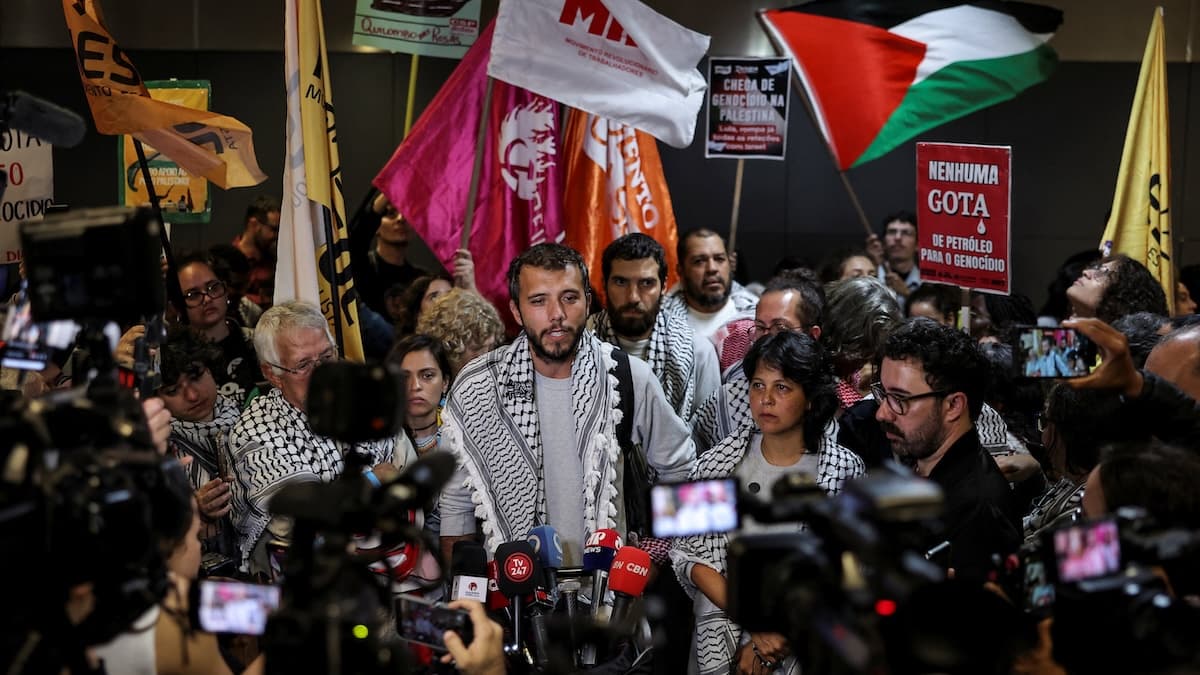
For the activists who choose to board those ships, the Global Sumud Flotilla is not just about reaching Palestine. It is about showing that conscience has no borders and about refusing silence. From Canada to Malaysia, hundreds of people came together to send a message that traveled farther than any ship could sail: Palestine is not alone.