
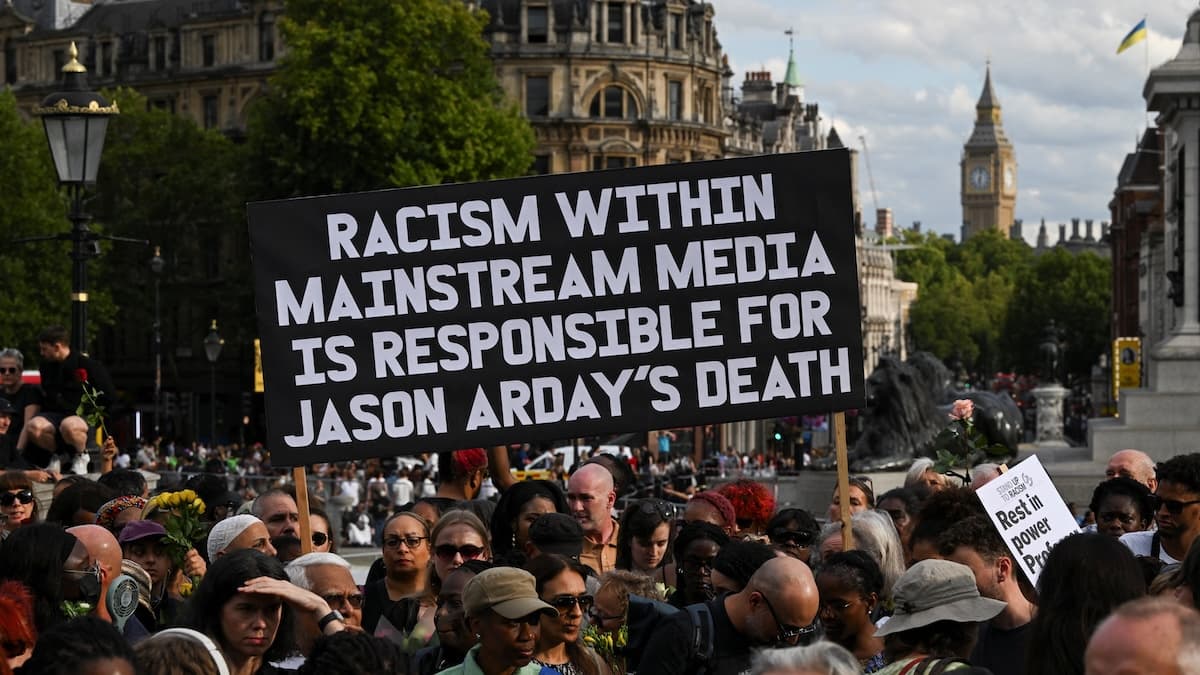
The death of Jason Arday this August should send shivers down every spine. The imperfect victim, carefully selected by predatory and racist media, ended up exactly how they wanted him.
The tragic death of the youngest Black professor in Cambridge University’s history was the result of relentless media hounding after allegations of plagiarism and autobiographical embellishments. What should have been dealt with via a professional process within the walls of the workspace quickly became a national debate. In a flurry of op-eds and radio talk shows, every talking head had suddenly become an expert in university hiring processes, DEI, and what constitutes plagiarism.
It was also the inevitable result of a racist, deeply anti-intellectual British media that purposefully resists nuanced conversation about what is happening at universities and the work of academics and students, and which invariably comes after academics and students of color.
For the racist mob, it would never have been enough for Arday to resign and step down from his post of professor at the University of Cambridge; he needed to be punished for having taken on the role of professor at a university that has traditionally represented Britishness and Whiteness so institutionally.
The “story” of Arday’s alleged academic misconduct entered the zeitgeist with a blog post by researcher Nathan Cofnas, a self-described “race-realist.” He wrote that in a meritocracy, the number of Black professors at Harvard University “would approach zero percent.” It’s telling that when The Times covered Cofnas’s article and the debate it sparked, they posed it as a question of “free speech,” rather than scrutinizing Cofnas’s own methodology, theoretical grounding, or academic rigor — everything that the media pretended to care about when it came to the allegations raised against Arday.
If there is anything the age of social media has shown us, it is that anger and outrage can be perfectly manufactured, and — for the sake of clicks, ad revenue and algorithmic success — that anger will be exploited at any cost.
Under normal circumstances, a case such as this would have been dealt with behind closed doors at the university (plagiarism allegations, though scandalous, are not as unheard of as one may think); a review is usually more than enough to clear a name.
Indeed, this actually happened with Arday. His alma mater, Liverpool John Moores University, had already found that allegations of plagiarism or any wrongdoing were not proven. A panel set up by the university concluded in March that issues in his dissertation were not due to deliberate plagiarism but from “honest and reasonable error” that was “well within the accepted range of compliance with the academic standards of the time.”
Cambridge was performing its own investigation into his academic qualifications and credentials. Despite that, the media pile-on only grew, fueled by far-right activists.
Even when a review does reveal misconduct, typically academics are often able to keep their posts — there is certainly no media pile-on. Take the case of Dr. William O’Reilly, who was accused of plagiarizing an undergraduate student’s work, or Professor David Latchman, who presided over a University of London laboratory that was found to have published a slew of fabricated research papers. The Guardian called it “one of the worst instances of research fraud uncovered in a British university.” Despite that, Latchman is now vice-chancellor at the same university.
Why was there no such media and far-right uproar for these academics? You won’t be surprised to know both O’Reilly and Latchman are white. The reason Professor Arday was targeted, even after his resignation, was racism.
But the groundwork for Arday’s takedown was built long ago, well before Professor Arday had even been appointed by Cambridge University. For years, the British media landscape has been coming for higher education, DEI, and theoretical paradigms of race, (de)coloniality, and gender.
Every few news cycles, a frenzied opinion piece will throw out unsubstantiated claims to incite a right-wing uproar. For example, a 2025 headline in The Telegraph opined that “academics want to ‘decolonise’ Stratford-upon-Avon.” The context: The Shakespeare Museum had announced that it would consider adding contextual information on how the British Empire may have informed Shakespeare’s writing. The article argues that “we should just celebrate his work,” as if critical interrogation negates celebrating the Bard.
To suggest there is no celebration of his work is to sow seeds of division: “they cannot and will not appreciate British culture” and therefore “Britishness is under attack.” This underpins the right’s approach to conversations about higher education and culture.
Other frantic, faux-outraged pieces call on students to resist “decolonization” and paint academic conversations about coloniality and racism as antithetical to students’ best interests. Readers are constantly reminded of the financial cost of university, as though there is a financial disservice now being committed — not because of the commercialization of education, but because of the bogeyman that is conversations about decoloniality.
This witch hunt did not begin with Professor Arday. In 2017, Cambridge student Lola Olufemi faced a slew of online abuse after The Telegraph published her photo on its front page alongside an article about an open letter signed by students who wanted greater diversity in their reading lists. The Telegraph’s caption read: “Student forces Cambridge to drop white authors”; later, it published a correction admitting that neither the recommendations nor the letter called for replacing white authors.
As Olufemi told The Guardian at the time, “This is a trend we see over and over again, hypervisible black and brown student activists on the left are subjected to the intellectual dishonesty of mainstream media. Our attempts to make progressive change are misconstrued, taken out of context and reframed to make us into targets of racialized and gendered harassment.”
Sowing the seeds of distrust against higher education not only encourages greater suspicion and ill-will against those in education. It inevitably gives way to conspiratorial thinking and media hysteria. It seeps into the public’s everyday thinking, encouraging black-and-white approaches, media harassment and manufactured anger that searches for any scapegoat. Once that scapegoat has been found, a vitriolic trial by public opinion will follow. Of course, the opinion will already have been decided by those professing to act in the public interest.
Now that Arday is dead in an apparent suicide, the media sites which published hundreds of inflammatory articles even after his resignation are now quick to say that he was failed by the university, by DEI initiatives, by a lack of mental health.
Everything failed him, apparently, except the predators across the political spectrum who turned Arday into a spectacle, built on faux-outrage, under the guise of public interest news. In reality, those who formed this mob had long been searching for someone to punish.