
It’s been more than a year since a special report from the Yale School of Public Health identified the heavy artillery that Sudan’s anti-government RSF force was using in its deadly bombardment of a large camp of internally displaced civilians. The AH4 155 mm howitzer, Yale researchers found, was made by Norinco — the Chinese state-owned weapons manufacturing conglomerate.
But as researchers noted in their report, there is only publicly-documented purchaser of this weaponry: the United Arab Emirates, which has long denied human rights organizations’ accusations that it has helped fund and arm the civil war swallowing up Sudan.
With more and more reports pointing to advanced Chinese-made arms being re-exported to the RSF paramilitary group by the UAE, and attacks on Sudan’s civilian infrastructure only continuing, it’s time for China to take practical steps to stem the flow of its weaponry.
Just last month, satellite images of Nyala Airport revealed that China’s BZK-005, the unmanned aerial vehicle developed by Beihang UAS Technology, had been deployed to an airport controlled by the RSF militia.
Supplying arms to the RSF, even via an intermediary such as the UAE, is a violation of the extended United Nations Security Council arms embargo, which China itself has endorsed. If it doesn’t act now, it risks becoming a partner in the ongoing war and the next genocide in Darfur.
A proxy war
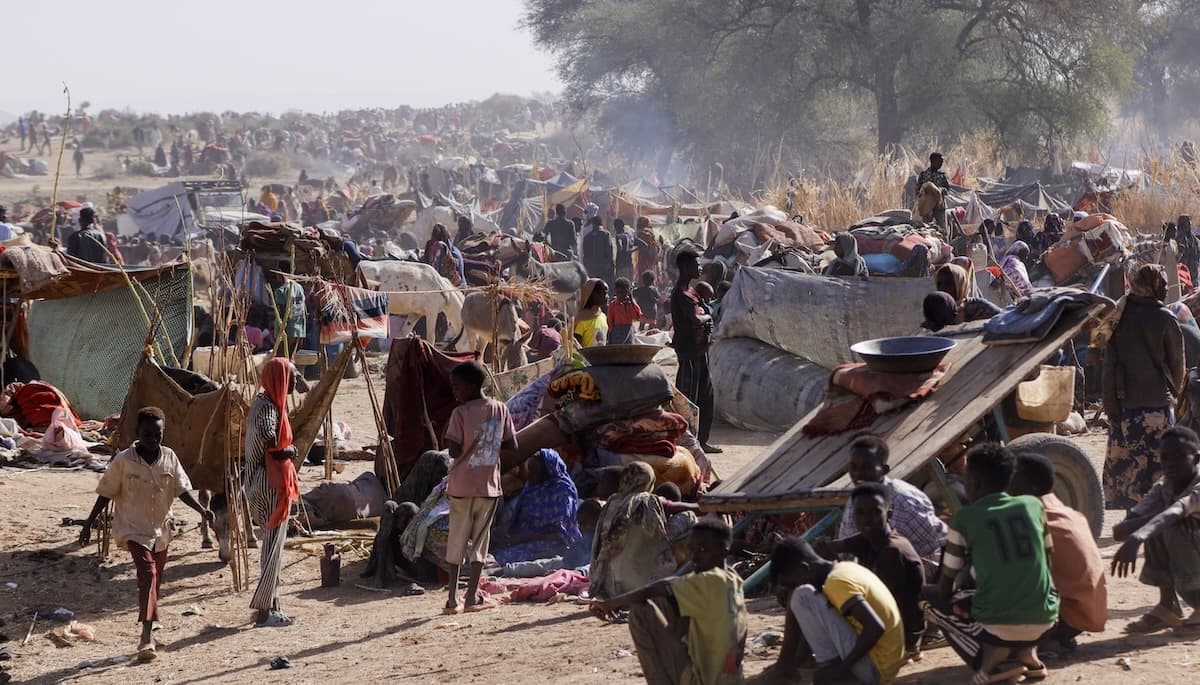
In April 2023, war in Sudan broke out between the National Army and the Rapid Support Forces militia. Its humanitarian impact has been severe, with millions displaced and thousands killed. While popularly called a civil war, the crisis in Sudan may be better understood as a proxy war, with the fighting having been sustained and prolonged by external actors. The most prominent of these is the UAE.
Journalists and human rights groups have extensively documented evidence of the United Arab Emirates providing the Rapid Support Forces with funds, arms and manpower, though it continues to deny this.
The RSF paramilitary originated mainly from the 2013 reorganization of the infamous Janjaweed militia, established to assist government counterinsurgency efforts in Darfur and South Kordofan. The Sudanese parliament formally legitimized its operations through legislation in 2017. Throughout the conflict, the RSF has been responsible for numerous atrocities, including village devastation, protester killings, sexual assaults, mass murders, illegal imprisonments, attacks on medical facilities and religious buildings, aggression toward media personnel and organizations, ethnically motivated violence, and the use of child soldiers.
For an extended period, the United Arab Emirates has provided financial and military backing to the RSF militia, including recently supplying foreign combatants. This assistance has substantially expanded since the conflict began. The UAE maintains significant economic and political stakes in Sudan that it anticipates will be protected if its RSF allies gain control. These interests encompass the exploitation of gold and agricultural assets, control of strategically important Red Sea ports, and blocking the return to power of Islamist groups, which the UAE traditionally opposes politically.
The impact of the UAE funding to the RSF militia has been devastating. According to UN experts, it’s estimated that the militia killed 15,000 members of the Massalit tribe based on their ethnicity. In other parts of Darfur, women have been raped and abducted, and children have been piled up and shot to death. For months, the city of Al-Fashir, the main refugee area in Darfur, has been besieged by the militia.
Last fall, the militia carried out one of the most brutal massacres yet in Al-Fashir. In a single day, thousands were slaughtered — among them hospital patients, women and children executed in cold blood. Satellite imagery has shown preparations for mass graves, a chilling attempt to erase evidence of this atrocity. The world cannot look away as the perpetrators of genocide in Sudan move to bury both their victims and the truth.
The role of the UAE and China
China is not officially backing the RSF, and its leaders have publicly called for protecting civilians and ending the war. The Chinese ambassador to Sudan has denied any connection with the weapons found in the arms of the RSF.
But independent analyses are increasingly connecting Chinese weaponry with violence in Sudan.
In early 2025, another report by the Yale School of Public Health showed that three unmanned aerial vehicles at Sudan’s Nyala Airport, which is controlled by the RSF militia, are most consistent with FH-95s manufactured by the Chinese company Aerospace Times Feihong Technology Company, or Feihong. To date, no conclusion has been reached about which country purchased and transferred these drones to the militia.
In May 2025, an investigative report by Amnesty International revealed that sophisticated guided bombs and howitzers used by the RSF militia, both in Khartoum and Darfur, were manufactured by the Norinco group. According to the Stockholm International Peace Research Institute, the only country that imported these arms from China was the UAE in 2019.
A few months later, in October, the U.S. intelligence also reported that the UAE increased its supply of Chinese drones and other weapon systems to the RSF militia.
As evidence mounts, China must urgently take the necessary measures and pressure the UAE to respect the end-user agreement and abstain from using its arms in the Sudan war. They must be held to account for their role in arming perpetrators of genocide.
In February, the United Nations Security Council opted — by a majority vote, in the absence of China — to renew its Sudan sanctions panel for one year It’s critical that this panel should closely monitor this issue and ensure that China adheres to laws and agreements and is not responsible, even indirectly, for prolonging the suffering of Sudan’s people.