
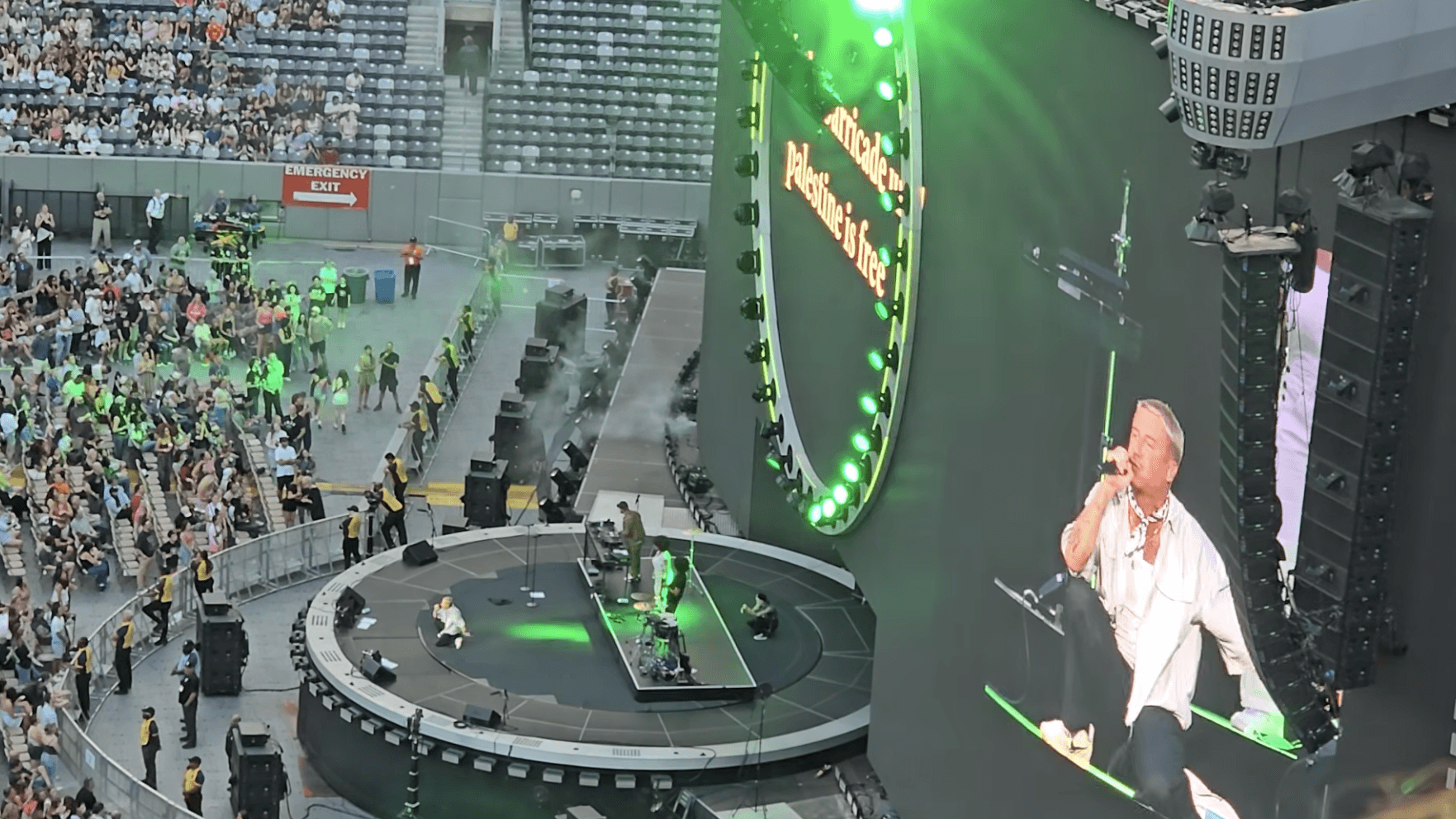
Ed Sheeran has had a rough month.
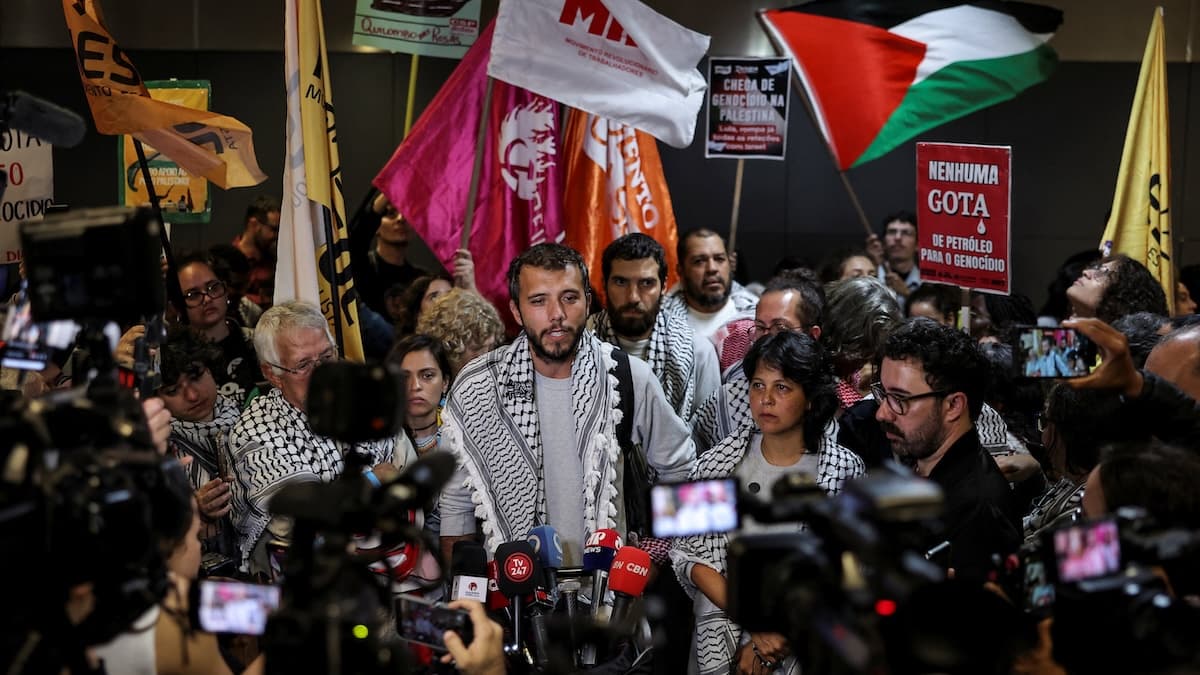
It started at MetLife Stadium in New Jersey in early September, where the pop star’s opening act, Grammy-winning rapper Macklemore, wore a keffiyeh and told the crowd he had joined the tour so he could stand up in stadiums and say two words: “Free Palestine.” Within days, Macklemore was off the tour. By Sept. 15, Sheeran’s remaining openers and his backing band had all quit in solidarity with Macklemore.
Sheeran says dropping Macklemore wasn’t his decision. According to Sheeran, multiple venues threatened to cancel their shows if Macklemore remained on the bill, leaving the promoter to make the final call. ButSheeran is no struggling artist; he is one of the biggest musicians in the world, with the drawing power to fill stadiums on several continents. He could have backed his opener and dared the venues to cancel, forcing them to explain their reasoning to thousands of ticket holders. Instead, at his next show in Philadelphia, he delivered a mealy-mouthed, prepared speech that didn’t say much at all.
But focusing on Sheeran’s choice skips past a more important question: Why was a stadium owner able to force that choice at all? That question leads to Robert Kraft, the billionaire owner of the New England Patriots and Gillette Stadium, where Sheeran is scheduled to perform later this month. In a 40-minute call to Sheeran, Kraft said that Macklemore would not be allowed to perform at his Boston-area stadium, and that he’d rallied other NFL stadium owners behind the same ultimatum.
For generations, Americans have understood freedom of speech largely through the language of government censorship: What can the state prevent us from saying? It remains an essential question, particularly at a moment when government pressure on universities, media organizations and other institutions is rampant. But in an age of extraordinary concentrated wealth, it is no longer the only question worth asking.
From stadiums to TV shows to social media algorithms, much of the infrastructure through which Americans encounter political ideas belongs to corporations controlled by extraordinarily wealthy people. Billionaires like Kraft do not control what Americans think. But a growing number of them own important channels through which political thought circulates, giving them tremendous power over who gets heard, what gets amplified and what speaking out can cost.
Kraft did not need to control Sheeran. He controlled something Sheeran needed: the venue. This is how private power can discipline speech without banning it.
What does free speech mean?
The First Amendment to the U.S. Constitution prevents the U.S. government from restricting free speech; private actors are still able to regulate, limit, or penalize speech on their own properties, platforms, or workplaces.
It generally does not require a privately-owned stadium, newspaper or social media platform to give anyone a microphone. But the distinction between the right to speak and control over the infrastructure that carries speech to an audience has become increasingly important.
Artists need venues. Workers need paychecks. Journalists need publishers. Media companies may need regulators to approve multibillion-dollar deals. Social media users depend on platforms whose owners write the rules governing what gets removed, promoted or placed in front of an audience. In each case, the person doing the speaking and the person controlling the infrastructure through which that speech travels do not possess equal power.
Legal scholar Monica Youn has written about what she calls “private chill,” in which anticipated retaliation by private actors can deter expression even without a government prohibition. The concept distinguishes the question of whether Macklemore’s constitutional rights were violated from the broader question of power. A person can remain perfectly free, in the narrow legal sense, to say something while having very good reasons to fear what saying it will cost.
Owning the newsroom
We got a particularly stark demonstration of that imbalance in the closing days of the 2024 presidential campaign.
The Washington Post editorial board had prepared a presidential endorsement when the newspaper abruptly announced, 11 days before the election, that it would not endorse a candidate. Billionaire owner Jeff Bezos, who purchased the Post in 2013, made the decision. He later defended it as a principled attempt to restore public trust, arguing that presidential endorsements create a perception of bias without actually persuading voters.
Around the same time, billionaire Los Angeles Times owner Patrick Soon-Shiong intervened in his newspaper’s endorsement process, prompting resignations from editorial board members. Soon-Shiong also defended his decision, saying he wanted the paper to give readers factual information rather than tell them how to vote.
Hundreds of journalists may produce a newspaper, but ownership can give one extraordinarily wealthy person the authority to overrule the institution’s editorial decision.
“We are now very dependent on the personal whims of rich people, and there are very few checks and balances on them,” Brookings scholar Darrell West told The Washington Post in a discussion of billionaire control of major communications institutions.
His point was not that billionaire owners inevitably push those institutions in any particular ideological direction. The problem is the extraordinary discretion that ownership confers. And that discretion increasingly extends beyond traditional media.
The 20th-century media mogul could own the newspaper or television station. The 21st-century billionaire can own the platforms and systems that decide which news stories, politicians, activists and memes appear in front of hundreds of millions — even billions — of people.
Owning the feed
Mark Zuckerberg provides perhaps the clearest example of how much authority can rest with one person. Meta’s Facebook, Instagram, WhatsApp and Messenger reach billions of people, while Zuckerberg’s share structure gives him controlling voting power over the company. Over the past five years, he has made dramatically different judgments about how political speech should operate on those platforms.
In January 2021, Meta suspended Donald Trump from Facebook and Instagram after the Jan. 6 attack on the U.S. Capitol, with Zuckerberg saying at the time that the risks of allowing Trump to continue using the platforms were “simply too great.” Four years later, after Trump’s reelection, Zuckerberg announced that Meta would end its U.S. third-party fact-checking program, loosen some restrictions on contentious subjects and bring more political content back into users’ feeds. He described the election as a “cultural tipping point.”
The rules governing political expression for billions of users could change because the man controlling the company changed his mind.
Some Americans possess speech; others possess speech and the stadium, the newspaper, the television network or the algorithm that determines whether millions of other people ever encounter it.
New research suggests that control of the feed can affect more than just what people see. In a Nature study published this year, researchers randomly assigned active U.S. users of X — as billionaire Elon Musk renamed Twitter after purchasing it — to algorithmic or chronological feeds for seven weeks. Users switched onto the algorithmic feed encountered more conservative political content, were more likely to follow conservative activist accounts and shifted toward more conservative positions on some policy priorities and political issues.
Robert McChesney, the late University of Illinois media scholar who spent much of his career studying concentrated media ownership, put it bluntly after Musk announced his plans to buy Twitter in 2022: “Even if Elon Musk was the smartest person on earth, had the best heart, had been touched by God, I wouldn’t want him to have that much power. It is antithetical to democratic political theory.”
Deciding which voices are amplified, which disappear into the feed and which rules govern billions of people’s participation in public life is an enormous amount of power.
When the state holds leverage, too
The distinction between private power and government censorship becomes more complicated when the government itself holds leverage over the billionaires who own media institutions.
Consider Paramount. While the company sought federal approval for its roughly $8 billion merger with Skydance, Trump was suing CBS (a Paramount entity) over the editing of a 60 Minutes interview with Kamala Harris. Paramount ultimately agreed to pay $16 million to settle the lawsuit without admitting wrongdoing, and the FCC later approved the merger.
Anna Gomez, the Democratic FCC commissioner who voted against the deal, described the sequence as part of what she called the administration’s “campaign of censorship and control” and warned that it created a dangerous precedent. When billions of dollars depend on regulatory approval while the president is simultaneously attacking a company’s journalism, the government possesses leverage over owners who, in turn, possess leverage over journalists. The two forms of power reinforce each other.
That should concern us regardless of who occupies the White House or what politics the billionaire owner happens to hold. A system that depends upon benevolent billionaires making good choices is still a system in which billionaires possess extraordinary power.
Power goes both ways
Some Americans possess speech; others possess speech and the stadium, the newspaper, the television network or the algorithm that determines whether millions of other people ever encounter it.
But the past few weeks have demonstrated that this power is not absolute. Macklemore exposed the NFL stadium owners’ threats and Sheeran’s cowardice with a social media post. Sheeran’s opening artists and backing band — Finneas, Lukas Graham, Aaron Rowe and Beoga — walked away from the tour to protest censorship of artists.
Their principled withdrawal and the widespread blowback has reportedly “startled” people within the Kraft organization and the tour’s promoter, per The Boston Globe. Kraft and Sheeran have each pledged $2 million toward Palestinian humanitarian aid since.
Kraft and the other venue owners had the leverage of ownership, but the musicians had the leverage of collective refusal — and fans have leverage through their attention and money.
Concentrated economic power is powerful precisely because challenging it carries a cost, but the price does not necessarily run in only one direction. Resistance can raise the cost for those exercising power as well, particularly when people act together.