
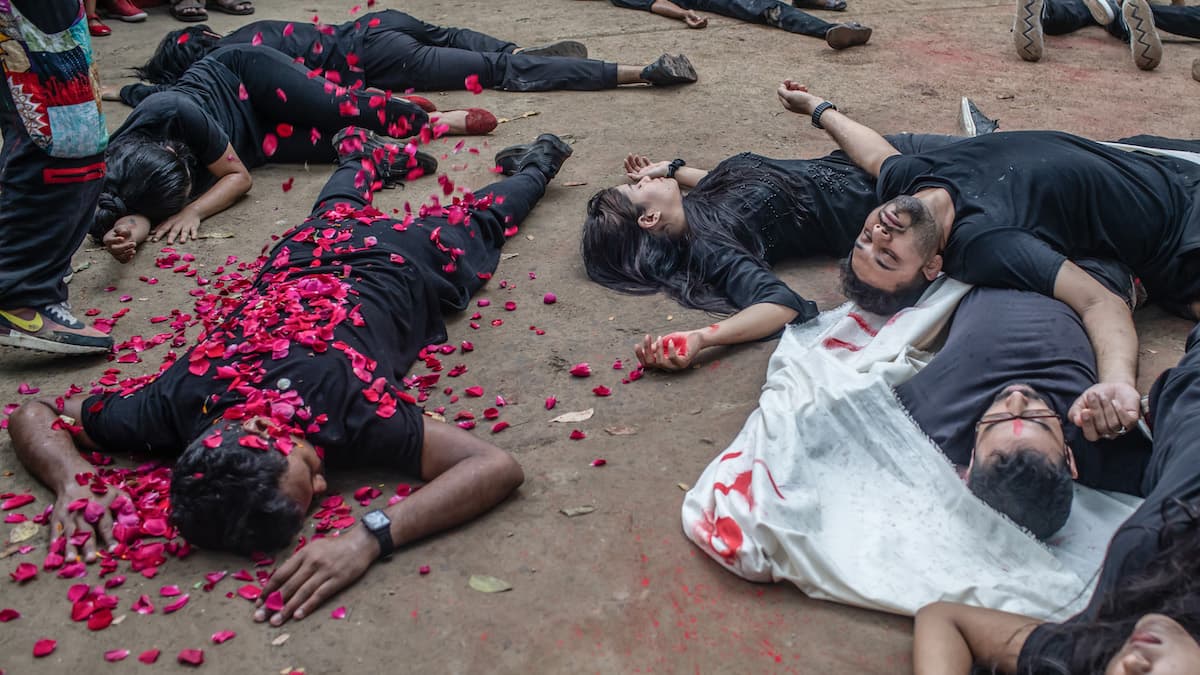
This piece was originally published in journalist Jennifer Chowdhury’s newsletter, PORT OF ENTRY.
On Oct. 7, 2023, I was five weeks postpartum with my second daughter. Each time I’ve become a mother, I’m filled with awe at the ability to bring a new generation into the world. As the child of Bangladeshis who survived the 1971 genocide, it feels miraculous that any of us are here.
Despite 3 million deaths over nine months, genocide in Bangladesh remains unrecognized by the United Nations, the United States and its perpetrators — the Pakistani government. Even many Bangladeshis from that generation hesitate to call it what it was: ethnic cleansing.
Since 1948, when millions of Palestinians were forcibly displaced to create the state of Israel, they have endured ongoing state-sponsored violence, death, displacement, famine and restricted access to aid — an unfolding genocide that has escalated since the events of Oct. 7. Hamas’s attacks provided the Israeli government with justification to unleash unprecedented levels of state violence in Gaza. These actions meet all the criteria outlined by Genocide Watch, yet many politicians and mainstream Western media continue to avoid defining it as such.
As I reflect on a year of genocide in Gaza, I think about the stories from my parents’ homeland and the memories they carry from ages 8 and 16, witnessing death all around them. My mother recounts, almost nonchalantly, tales of cash sewn into hidden pockets in her and her sister’s coats as they walked miles from the capital to seek refuge in the countryside. Once they arrived, my heavily pregnant grandmother gave birth to a stillborn fourth child. When my grandfather went missing for a few days, his brother-in-law turned over the dead bodies in the streets, to see if any of them were his sister’s husband.
My teenage father itched to join the fight to protect a centuries-old culture and 65 million-strong community that the Pakistanis wanted to erase to emerge as the dominant culture.
Since the 1947 partition of India and Pakistan, the Bengalis of East Pakistan endured famines, cyclones and floods while being denied humanitarian aid, life-saving resources, and political representation by the West Pakistani government. They faced prejudice for their darker skin tone and shorter stature, as well as for the religious harmony that existed between Hindus and Muslims and the shared rituals between them. Additionally, they were determined to uphold the strength of their language, refusing to trade it for the dominant Urdu.
When they dared to demand fair political representation after winning the 1970 Parliamentary elections, the Pakistani military launched Operation Searchlight in the dead of the night —targeting intellectuals, journalists and other important members of society. The largest massacre took place on the campus of Bangladesh’s most well-known university and the center of intellectual life.
Since Oct. 7, an estimated 885 healthcare workers in Gaza and the West Bank have been killed by Israeli forces. According to the Committee to Protect Journalists (CPJ), at least 128 journalists and media workers have been killed, making this the deadliest conflict for journalists in the last 30 years. Universities and schools in Gaza have been reduced to rubble. Genocidal intent frequently targets the foundational pillars of society first, and for a year, we have been witnessing this destruction unfold in real time on the internet.
Western imperialism’s aiding and abetting of ethnic cleansing
In the American education system, we were never taught about the genocide in Bangladesh or the true events surrounding the decades-long illegal occupation of Palestine in the same way we learned about the Holocaust, Rwanda or Bosnia. The death toll during the nine-month liberation war that led to Bangladesh’s independence surpasses that of the three U.N.-recognized genocides, yet it still does not receive recognition as ethnic cleansing.
I learned much later in life that the United States actively refrained from intervening to stop Pakistan’s killing spree. In 1971, U.S. diplomats sent urgent reports to Washington, D.C., alerting officials to the mass killings, but the administration not only turned a blind eye; it also supported Pakistan, an important ally in the fight against the Soviets and a strategic geopolitical gateway into China.
In his memoir View From the U.N. (1978), former U.N. Secretary-General U Thant compellingly argues that “the genocide in Bangladesh and the corresponding humanitarian crisis were politically ignored, partly due to the wartime ideological differences between the U.S. and the Soviet Union and their allies.” U.S. Secretary of State Henry Kissinger infamously dismissed alarming reports of genocide in East Pakistan as a “basket case,” deeming the dire situation unworthy of the White House’s attention.
The aftermath of genocide: Triumphalism
The Pakistani government has yet to acknowledge the atrocities committed by its army in Bangladesh in 1971 and it is completely dismissed in Pakistan’s history books. In contrast, the IDF has come under international scrutiny for showcasing its war crimes and acts of violence through TikTok videos and Instagram posts, while Israeli musicians have released songs that glorify the deaths of Palestinians.
Hariz Halilovich, a Bosnian-Australian scholar, created the term “triumphalism” and claimed that it added an eleventh stage to Stanton’s classification if genocide went unpunished.
According to Halilovich, “In this stage, perpetrators, their sponsors, and the politics behind genocide do not deny the killings any longer, but rather they glorify them, celebrate their deeds, humiliate the survivors, build monuments to the perpetrators at the sites of the massacres, and create a culture of triumphalism such as has been seen in the parts of Bosnia where Serb militias committed genocide against Bosniaks.”
The U.S. has played a significant role in enabling Israel’s triumphalism by providing at least $12.5 billion in military aid, making Israel the largest recipient of U.S. military assistance in history, despite repeated calls for an arms embargo from activists. Even the prospect of losing presidential elections has not swayed the Democratic Party from its stance on providing military support to Israel under the justification of its “right to defend itself.”
Bangladesh-Palestine solidarity
Bangladesh and Palestine have a long history of solidarity, even before the nation of Bangladesh was established by sending Eastern Pakistani forces during the 1967 Six-Day War. Bangladesh is one of the 137 countries to recognize Palestine as a state since the Palestinian Declaration of Independence on Nov. 15, 1988. In 1987, 8,000 Bangladeshi youths volunteered in Lebanon to fight in the Palestine Liberation Organization.
Israel has made several attempts to establish diplomatic relations with Bangladesh over the past 50 years. Although Israel was one of the first countries to recognize Bangladesh’s independence, Bangladesh rejected Israel’s help during its liberation war.
Since gaining independence, Bangladesh has faced persistent political challenges, culminating in a surprising popular uprising that ended Prime Minister Sheikh Hasina’s 15-year rule. But despite internal political conflicts, Bangladeshis remain united in their position on Israel: They will never support a state involved in genocide or the illegal occupation of land.